
Water-resistant adhesive labels: discover suitable materials and finishes


Waterproof adhesive labels are designed to maintain adhesion, legibility, and visual quality even in the presence of humidity, condensation, washing, low temperatures, or frequent handling.
For a company, choosing the right label isn't just about preventing it from peeling off: it's about protecting information, traceability, product image, and supply chain continuity.
Index
Introduction
What does water resistant label really mean?
Where to use waterproof adhesive labels
Materials, adhesives, and finishes: what to consider
How to choose the best waterproof label
Mistakes to avoid, FAQs, and helpful resources
Conclusions
Introduction
If your company produces food, cosmetics, chemicals, pharmaceuticals, industrial products, or items intended for logistics, refrigeration, or large-scale retail trade, the label may be exposed to very different conditions than those on a normal shelf.
Water, humidity, condensation, ice, detergents, oils, rubbing, and temperature changes can compromise adhesion, readability, and aesthetics.
For this reason, waterproof adhesive labels must be designed considering the entire system: facestock, adhesive, printing, finishing, packaging surface and actual conditions of use.
A label may look correct on a sample, but behave differently on a wet bottle, a cosmetic bottle, a frozen package, a chemical container, or logistics packaging.
What does water resistant label really mean?
A waterproof label is not simply a label that “doesn’t get wet.”
In everyday language, terms such as waterproof labels , moisture-resistant labels , or condensation- and ice-resistant labels are often used. In the B2B sector, however, it is important to distinguish between the different conditions of use.
It's one thing to withstand a few drops of water. It's another to remain readable after hours in the refrigerator. It's yet another to withstand condensation, immersion, washing, oily products, or chemicals.
Water resistance: the levels to distinguish
When evaluating a label, you should ask yourself what type of exposure it will be subjected to:
environmental humidity: typical of cold storage rooms, damp warehouses, bathrooms, spas or production environments.
Condensation: Common on cold bottles, refrigerated and frozen products, and packages that go from cold to room temperature.
direct contact with water: concerns beverages, bathroom cosmetics, detergents, sanitary products or packaging subject to washing.
Ice and low temperatures: critical for frozen and deep-frozen products and packaging intended for large-scale retail trade or cold storage logistics.
Rubbing and handling: Even if the material is water resistant, the printing must remain legible during transport, use and handling.
Substances other than water: oils, creams, detergents, light solvents, or chemicals may require specific materials and finishes.
Bottom line: The real question isn't just "is this label waterproof?", but what type of water, for how long, on what packaging, and in what process?
In which sectors are waterproof adhesive labels useful?
Waterproof adhesive labels are useful in any industry where packaging comes into contact with moisture, liquids, or harsh environmental conditions.
This isn't just a solution for bottles or refrigerated products. It's a versatile label type, highly relevant for companies that need to ensure aesthetic continuity, traceability, and legibility.

Food & Beverage
In the food industry , water resistance is important for:
bottles of water , wine , beer, soft drinks and spirits;
refrigerated packages;
fresh produce;
frozen or deep-frozen foods;
trays, flow packs, bags and containers intended for large-scale retail trade.
In these cases, the label may be exposed to condensation, ice, cold storage, refrigerated counters, logistics handling, or contact with damp surfaces.
For food products, it is also important to evaluate any food contact requirements, if the label or its components may come into direct contact with the food.
Cosmetics and personal care
In the cosmetics industry, labels often need to resist water, humidity, oils, creams, and frequent handling.
Think about:
shampoo;
balms;
body creams;
serums;
facial cleansers;
shower products;
cosmetics used in the bathroom, spa or beauty case.
In this sector, resistance isn't just technical. It's also perceptive.
A label that wears off, stains, or lifts after just a few uses can tarnish a brand's image, especially on premium or skincare products.
Chemical, pharmaceutical and healthcare
In the chemical , pharmaceutical and healthcare sectors, labels often must maintain legibility and adhesion even in the presence of humidity, handling, controlled environments or potentially aggressive substances.
It can be used on:
bottles;
canisters;
technical containers;
cleaning products;
devices;
sanitary packaging;
secondary packaging.
In these cases, the readability of codes, batches, expiration dates, warnings and technical information is a key aspect.

Industrial, automotive, logistics and warehouse
In the industrial and automotive sectors, labels can be exposed to moisture, dirt, oils, friction and temperature changes.
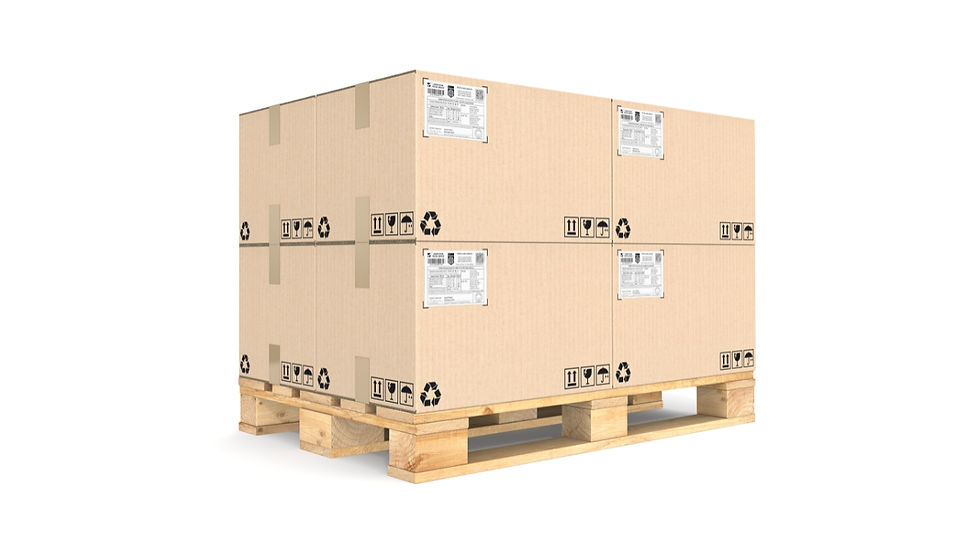
In logistics and warehousing, however, water resistance is important to protect:
barcode;
product codes;
lots;
pallet labels;
department identifications;
shipping labels;
traceability information.
If a code becomes illegible, the problem isn't just aesthetic. It can impact the operational management of the product.
Refrigeration and frozen foods
For refrigeration and frozen foods, water resistance is related to condensation, ice and low temperatures.
A package destined for the freezer or the cold chain can undergo passages between different environments: production, chilling, storage, transport, display and handling.
In this context, the label must remain stable not only on the refrigerated display case, but throughout the product's entire lifecycle.
We've written a more detailed article on freezer labels, which you can read by clicking here.
Materials, adhesives, and finishes: what to consider
Choosing a waterproof label doesn't depend on just one material.
It's the result of a proper combination of substrate, adhesive, printing, and finishing. For this reason, a valid solution for a beverage bottle might not be suitable for a cosmetic bottle, a frozen food container, or a chemical container.
The following table compares some common solutions.
material or solution | when it can be useful | main advantage | technical attention |
damp-proof treated paper | beverages, fresh food, products with moderate exposure to humidity | good graphics rendering and natural look | not always suitable for intense or prolonged contact with water |
PP film | cosmetics, food, refrigerated products, flexible packaging | good resistance to humidity and handling | must be combined with an adhesive consistent with the surface |
PE film | flexible packaging, squeezable containers, personal care products | good adaptability on deformable surfaces | check dimensional stability and graphic rendering |
PET film | technical, industrial, chemical products or more demanding applications | greater stability and resistance | can be oversized for simple applications |
transparent material | beverage, cosmetics, premium packaging | no-label-look effect and integration with the pack | Be careful of bubbles, condensation, adhesive and readability |
lamination or protective varnish | products subject to rubbing, water or handling | protects print and surface finish | can alter color perception, opacity or brightness |
water resistant adhesive | wet, refrigerated, frozen or washable packaging | improves pack hold in critical conditions | it should be chosen based on surface area, temperature and usage cycle |
This table is not a substitute for a technical assessment. It serves to clarify that there is no single "best waterproof label." There is a solution that best suits your product, your packaging, and your process.
The front material
The face material is the visible part of the label.
It can be made of treated paper, plastic film, transparent material, metallized substrate, or other technical solution. It must guarantee aesthetic appeal, printability, and resistance to the expected conditions.
For products exposed to a lot of water or humidity, plastic films such as PP, PE, or PET are often preferable to standard paper. However, treated paper may also be suitable for less critical applications or when a more natural look is desired.
The sticker
The sticker is one of the most delicate points.
A label may have a water-resistant face material, but still peel off if the adhesive is not suitable for the surface or conditions of use.
Before choosing the adhesive, you need to evaluate:
pack surface;
presence of humidity at the time of application;
application temperature;
storage temperature;
rigidity or flexibility of the container;
possible presence of oils, dust or residues;
expected life of the label.
In some cases, a high-strength permanent adhesive may be necessary. In others, a removable or low-temperature adhesive may be necessary. The choice depends on the project.
Printing and surface protection
Water resistance isn't just about the label substrate. It's also about the print.
Text, codes, graphics, barcodes, and variable data must remain legible even after exposure to moisture, rubbing, or handling.
For this reason, the following may be useful:
protective paints;
matt or glossy laminations;
thermally protected materials;
inks suitable for the substrate;
printing technologies consistent with the project.
A finish can improve durability, but it must be chosen carefully. It can affect the color, feel, reflection, sustainability, and recyclability of the packaging system.
How to choose the best waterproof label

Let's learn together how to evaluate waterproof adhesive labels as part of the packaging, not just as a simple graphic support.
The correct choice always starts from the actual use of the product.
How to do a first technical test
To reduce the risk of errors, testing should be done on actual packaging.
Helpful evidence may include:
application on the final pack;
initial membership verification;
exposure to water, condensation or humidity;
test after refrigeration or freezing, if applicable;
checking the readability of texts;
barcode, batch and variable data verification;
aesthetic evaluation after manipulation;
sealing check on curved or flexible surfaces.
The test isn't just about whether the label "stays on." It's about whether it retains its intended function.
Why the actual packaging is crucial
A label may work well on a standard sample, but cause problems on the final product.
That's why, as an industrial label maker, we don't just print a file. We help you evaluate the solution best suited to your product, packaging, and production process.
Conclusions
Not all waterproof adhesive labels are created equal.
To choose the right solution, you need to evaluate the product, the packaging, the environment, the application surface, the temperature, the type of water exposure, and the information that must remain legible.
Since an incorrect choice can cause real problems, labels shouldn't be chosen solely from the catalog or based on the artwork. They should be designed as part of the packaging system.
Contact us for technical advice on your waterproof adhesive labels.


Comments